22 September, 2013

Rock Revelations I: The Byrds

This is the first in a series of posts that will describe significant musical epiphanies I've experienced. It covers the 1965-67 period of The Byrds' original lineup.

Now, I'd love to be able to say that I saw The Byrds live at the Whiskey a Go-Go in LA back in '65 or on their hugely successful British tour later that year. But no such luck. I was only six and my parents were pretty strict. No, the closest I ever got to an actual Byrd was the 1995 email reply I received from Roger McGuinn after politely enquiring when he'd be touring Australia again. I don't know when, but I shall return, was his delightfully MacArthur-esque answer.

And sure, I'd noted the 1978 Australian tour of McGuinn, Clark and Hillman alright, but not enough to go to any of their gigs. Regrets? I've had a few. You see, at that time, The Byrds were very much on the periphery of my musical interests.

It would be 2005 before I'd catch a terrific Sydney solo gig of McGuinn's on the excellent ABC-TV program Live at the Basement, but you can't say he didn't keep his word.

I'd originally come to The Byrds via some earnest teenage over-enthusiasm for Crosby, Stills, Nash and Young back in 1976. I wanted to explore the earlier work of the members of the first American supergroup, and I thought purchasing The Byrds Greatest Hits would do the job nicely. My 17 year old self liked it enough but thought all those Dylan covers were a little on the insubstantial side.
To be fair, I rated The Byrds much more highly than those other CSNY precursors Buffalo Springfield and of course, The Hollies, and I could see how they must have been very influential - how later groups like Poco, America and the Eagles clearly owed a debt to The Byrds' country-folk-rock stylings. But under my somewhat injudicious scrutiny, their mid-60s incarnation came out looking like a pre-Monkees attempt to cash in on the British mop-top phenomenon.

It was The Byrds' appearance on Dancing in the Street, BBC-TV's brilliant 1995 documentary series on the history of rock and roll, that made me want to explore their catalogue in more detail through fresh, better-informed eyes. You could call it a Damascene convyrsion. I had become a Nyrd, having learned enough from that series to develop a heightened appreciation of the pivotal nature of The Byrds' influence - how they weren't just a group that sounded a bit like later country rock bands - that they'd laid all of the groundwork for subsequent artists who would make a lot more money than The Byrds ever did.


The Byrds featured in two episodes of Dancing in the Street: Episode 3: So You Want to be a Rock and Roll Star, which covered folk rock; and Episode 6: Eight Miles High, on psychedelic rock. As you've  probably realized, both of those episodes carry the titles of emblematic Byrds' songs.


So You Want to be a Rock and Roll Star features the Byrds from the 20:20 mark (I would highly recommend watching the entire episode if you haven't seen it) and the narrative puts a compelling case for The Beatles, Dylan and The Byrds as a triumvirate of bridges between folk music, as it then was, and rock and roll.
McGuinn in particular talks about how he found considerable synergy between his folk roots and the kind of structures present in most Beatles songs. How George Harrison's use of the Rickenbacker 360/12, a 12-string electric guitar during the movie A Hard Day's Night inspired McGuinn to meld those key influences into a distinctive new sound that would be very much The Byrds' own.
Dylan had already done all of the groundwork re-defining and revolutionizing folk music, so McGuinn took Bob's recent composition Mr Tambourine Man, changed its time signature from 2/4 to 4/4 and tacked on the now-iconic Bach-derived intro. Producer Terry Melcher's lack of confidence in The Byrds' musicianship meant that all instrumentation except for McGuinn's Rickenbacker were provided by the Wrecking Crew. But there was no doubt rock music had reached a significant watershed.

With a Number One hit on their hands, The Byrds' jangling proved to be profoundly influential, all at once accelerating and validating Dylan's move to electric instrumentation and providing the most distinctive motif running through this new genre of folk-rock during 1965-66. Simon and Garfunkel's The Sound of Silence would have electric 12-string guitars added in post-production and I Can't Explain, The Who's first single, would also be driven by the Rickenbacker 360/12.

But The Byrds weren't finished pushing boundaries.

They come on pretty early at 2:13 during Episode 6: Eight Miles High. And why not? Their haunting January 1966 single pretty much started the whole psychedelic phenomenon. Again, I urge watching the whole thing if you've got time - it's well worth it.
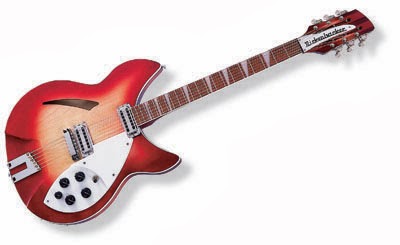
After the immense success of Mr Tambourine Man and immediate follow-up hits such as Turn, Turn, Turn, McGuinn found himself looking for a way to further explore the potential of his ever-present electric 12-string guitar. He found it in an unlikely place.

McGuinn had become fascinated with the music of jazz-saxophonist John Coltrane, and felt that the Rickenbacker 360/12 might provide a means of paying homage to Coltrane's stylings. A Byrds composition, Eight Miles High would feature double-entendre lyrics (aeroplane flight or drug-induced trip? You decide.), an eerie melody from Gene Clark, some exciting rhythmic contributions from David Crosby and superb vocals.

Despite being unofficially blacklisted from radio airplay due to moralistic pressure group influence, Eight Miles High would prove just as influential as Mr Tambourine Man, almost eighteen months before the Summer of Love. 

After watching this series, I couldn't get enough of the song Eight Miles High and listened to it incessantly. I played The Byrds Greatest Hits again and again to make sure I hadn't missed anything. And I thought it was worth betting that non-compilation studio albums by the Byrds could well contain some great unheralded material. To the record shops!

First priority was getting a hold of the album that featured Eight Miles High, 5th Dimension. And my timing was impeccable, because Columbia had just released the re-mastered Legacy reissue versions of the Byrds' back catalogue with bonus tracks. On 5th Dimension, their third album and the first without the recently-departed Gene Clark, bonus tracks included an earlier version of Eight Miles High recorded at RCA. Crosby preferred this slower, moodier alternate take but I'm inclined to favour the final Columbia version.

Other standout tracks are the folky Wild Mountain Thyme, the underrated Hey Mr Spaceman, Crosby's I See You and two other bonus tracks: I Know My Rider and Why. Overall, 5th Dimension hangs together pretty well as an album without being spectacular.
 
Next on the shopping list was The Byrds' second album, Turn, Turn, Turn, the title track of which was their biggest hit. The only other really good song on the original track listing is It Won't Be Wrong, but there are two dynamite bonus tracks in She Don't Care About Time, one of Gene Clark's finest compositions and featuring a great drum pattern reminiscent of Ticket to Ride from Michael Clarke, plus a lovely cover version of Dylan's It's All Over Now, Baby Blue.


The Byrds' first album, which took its title from their hit single Mr Tambourine Man, made the cash register ring next. This album is studded with entries from The Byrds' Greatest Hits including the Gene Clark penned I'll Feel a Whole Lot Better, The Bells of Rhymney, All I Really Want To Do and Chimes of Freedom.

Another Gene Clark composition, the poignant Here Without You, is a great unsung Byrds album track that deserves a higher place in the Byrds' canon, even if only because it is an obvious melodic precursor to Eight Miles High.


The Byrds' fourth album, Younger Than Yesterday, seems to follow logically from 5th Dimension and it is here that David Crosby's dreamy compositions Everybody's Been Burned, Mind Gardens and the bonus track It Happens Each Day arguably represent an early peak for his songwriting. I've always loved So You Wanna Be A Rock and Roll Star with its counter-intuitive trumpet from Hugh Masekela and My Back Pages is another significant Dylan cover.

There's also a more eastern-influenced version of Why and a catchy first-up songwriting credit for bass player Chris Hillman in Have You Seen Her Face.


I know a lot of Nyrds regard this album highly but I couldn't find too many redeeming features on The Notorious Byrd Brothers apart from I Wasn't Born To Follow, a song that would later appear on the Easy Rider soundtrack. You could have knocked me over with a feather when I found out it was a Goffin-King composition.

Internal tensions ran rife through the sessions and David Crosby would either leave or be fired (depending on whose version of events you believe) during the recording of The Notorious Byrd Brothers.


It's a shame that The Byrds didn't produce an album of the quality that would have done justice to their talent and influence from their first five attempts. Maybe if some of the outstanding bonus tracks had replaced the lesser album tracks. That said, you probably need to be mindful of the fact that rock music wasn't album-oriented during The Byrds' peak period during 1965-67 - it would take the Beatles' Rubber Soul (1966) to start to alter the industry's emphasis on albums over singles, and that wouldn't be fully realized until 1968, the first year that albums outsold singles.

That said, I would highly recommend the Legacy reissues of The Byrds' albums for their enhanced production values and bonus tracks of unusually high quality.

You may have gleaned from all the prose north of here that although I'm a fan of The Byrds, it's not unconditional. My view of the Byrds could best be summed up by one of the bonus tracks on Sweetheart of the Rodeo: the bluesy Reputation. I think it's a terrific song, a folk-country-blues-rock 12-bar that seems to have everything. But the bass drops out during  the second verse, causing the song to lose a fair bit of momentum. It kicks back in fairly promptly, but the damage has been done and that's probably why it didn't make it onto the original album.

And that's pretty much an encapsulation of their career for me: I love and admire them for the peaks in their output and all they inspired, but that intangible nagging feeling of how much better they might have been is inescapable.

02 September, 2013

Classic Albums Augmented VIII: Everybody Knows This Is Nowhere

Neil Young with Crazy Horse: Everybody Knows This Is Nowhere - Sugar Mountain
Everybody knows this isn't Harvest. But remarkably, Neil Young's 1969 solo outing, his second after leaving Buffalo Springfield, is a better album than the ubiquitous 1972 LP that everyone's familiar with. That's probably a big statement. Iconoclastic even. But I also rate Young's On The Beach (1973) more highly than Harvest, so it figures.

Anyway, this post is not designed to do a Mythbusters on Harvest. You can read what I had to say about it here. And a great article comparing Harvest and its lesser-known follow-up On the Beach here.

I'm listening to Everybody Knows This Is Nowhere on CD these days, converted from my original vinyl by way of a judiciously purchased digital turntable. As with all of the other LP conversions I've done, the sound of the needle landing on the LP at the beginning of each side has been left in the finished collection, just for old times' sake.

I wasn't expecting to like this album as much as I do after not hearing it for over twenty years. My recollection was of a couple of plodding near-dirges and extended jams taking the last two tracks on each side, at eleven and nine minutes respectively. But Everybody Knows This Is Nowhere is a fine album, and I'm glad I didn't dawdle in getting it onto CD.

The album seems to celebrate its lack of polish in exploring the interweaving folk and country roots that Neil Young drew on and still does. His mournful, almost drunken vocals must have sounded jarring to many listeners back in 1969, but they'd feel no such misgivings in the ensuing decades. The vocal track is actually a guide vocal recorded directly through the mixing desk, and is consequently unadorned with the usual enhancements like reverb. Young had a hunch that was what would suit the sound he was after and I'm inclined to agree with him.

Backing band Crazy Horse's reputation for looseness doesn't really amount to much here. Danny Whitten's guitar complements Young's very nicely and there's a clear combination of both versatility and virtuosity across what is an authentically rootsy album.

Everybody Knows This Is Nowhere opens with my all-time favourite Neil Young song: Cinnamon Girl. There's a great opening riff and some very heavy guitar playing throughout. Most people I've played it to are surprised that Neil Young could produce such a knockout rock song, but that probably highlights why there's a need for exploration beyond the better-known albums in the Neil Young catalogue.

The Byrds-like arpeggio that plays over the verses and then segues seamlessly back into the riff is so insistent that you hardly notice the guitar solo staying on the same note all the way through. Cinnamon Girl is a welcome staple of Young's live act and I've seen it faithfully covered by Joe Walsh at the Prospect Hill Hotel in 1985 and also by the underrated Diesel at the MCG a few short years ago.
The title track is a countrified song with a fun feel and chorus that builds to a catchy melodic hook, while the droning Round and Round swirls slowly. Down By The River is an ominous murder ballad that becomes an extended eleven-minute jam. I really wasn't expecting much from this opus after not hearing it for years but the dynamic variation ensures it never becomes a drag.

The Losing End has a jauntily depressing country flavour to it, while Running Dry sees a mournful Young at his most quietly despairing, set against a backdrop of Appalachian-sounding violin. Cowgirl in the Sand is another of Young's pieces that segues into an extended jam and as such, functions as an effective companion piece to Down By The River. Some of you may be familiar with thelive version, delivered acoustically on Crosby, Stills, Nash and Young's double-live set 4 Way Street (1970).

Let's face it, this album is not going to be improved to any great extent by the addition of Sugar Mountain. So my suggestion here is a case of giving the album some closure - it has only seven tracks after all, and it's not an incongruous inclusion. You might be surprised to learn that Sugar Mountain, a live recording from 1968, had been the B-Side of two of Young's early singles and never appeared on an album until the 1978 three-record retrospective set Decade.

It's a wistful, child-like ballad that became a minor hit in the wake of Decade's 1978 release. Young had written the song in 1964 and it documents his fond memories of growing up in Winnipeg.

So Which Tracks Would Miss Out? None - Sugar Mountain can be added without the album exceeding 45 minutes.

14 August, 2013

Classic Albums Augmented VII: Beggars' Banquet

Rolling Stones: Beggars' Banquet - Jumpin' Jack Flash

Hitting the shops in December 1968, Beggars' Banquet was the album that signaled a return by the Rolling Stones to their bluesy roots after the psychedelic experimentation of Their Satanic Majesties Request, released 12 months earlier.

This is the original cover of the album, but it only became available upon its 1986 CD release because sufficient time had passed for a toilet wall covered in graffiti to become non-controversial. However in 1968, the stand-off with a nervous Decca record company, delayed the album's release until the Stones backed down over this affront to contemporary sensibilities.

Meanwhile, the cover eventually chosen by the Stones to replace the original was also controversial, but for different reasons.

You see, the all-white cover meant that they had once more chosen something very similar to what The Beatles had already done. And so just as the cover of Their Satanic Majesties Request drew unfavourable comparisons with that of The Beatles' Sgt Pepper's Lonely Hearts Club Band, the revised artwork on Beggars' Banquet looked very, very similar to the Nov 1968 double-LP The Beatles, aka The White Album. It seemed as though the Stones' just couldn't help themselves.

This is the cover they should have opted for:

The image actually looks like a beggars' banquet for starters, so it makes more sense than the toilet wall. And this particular shot is a much better take from the photo shoot than the re-touched image that spreads across the inside of the album's gate-fold cover.

But I digress. This album was the latest entry in the emergence of rock music, taken for granted these days but in 1968, a term that appeared to encapsulate the music that defined this watershed year. It wasn't rock and roll, nor was it rhythm and blues. It wasn't beat music, nor was it psychedelic. And even though this apparently new classification drew on all of those influences, and at times added folk, jazz and country influences to the mix for good measure as well, it was a case of the whole being greater than the sum of its parts.

This new release was to be something of a test for the Stones. After their previous album was largely dismissed as self-indulgent psychedelic meanderings, the Rolling Stones needed to recapture a fan-base that would quickly move onto newer, cooler sounds if their attention wasn't gained and held. And the track listing delivers.

Beggars' Banquet opens with the samba-like rhythms of Rocky Dijon's congas on Sympathy for the Devil. Jagger based the lyrics of this powerful first-person narrative on the novel The Master and the Margarita. A fascinating insight into the recording sessions is provided by Jean Luc Godard's film One Plus One, which shows the evolution of the song through many different stages. I have to confess to liking Brian Jones' acoustic guitar part as depicted in the documentary and lament its being left out of the finished track, but Richard's soloing is stinging and heavy and as good as he's ever done. And the whoo-whoo vocal punctuations are a distinctive feature.
The mournful country feel of No Expectations contains slide guitar by Brian Jones that would end up being his last major guitar contribution, while Nicky Hopkins' evocative piano playing explains why he was the Stones' first choice piano player for the next six studio albums. These burgeoning country influences are taken further on the riotously satirical Dear Doctor, but without sounding phoney, while Parachute Woman delivers a smouldering, bluesy ambience that fits with the blues-rock flavour of the times. Concluding Side One, Jigsaw Puzzle is a mature, Dylanesque reflection on rock stardom and its pressures. It's a shame Keith's slide guitar playing on this track is well, crap, but who would have had the nerve to tell him?

Opening Side Two is Street Fighting Man, one of my very favourite Stones songs. It explores similar themes to the Beatles' Revolution, but with understated sitar, droning feedback, crashing open-tuned acoustic guitars and thundering drums. To me, it's always sounded like something of a companion-piece to Jumpin' Jack Flash and I just love its overall atmosphere.

Prodigal Son, written by Rev Robert F Wilkins, is an unashamed and unadorned homage to traditional Memphis-style blues, with Richard's open tunings and Jagger's baritone delivering the goods. You could consider the overtly sexual Stray Cat Blues as the precursor to a style Led Zeppelin would later make their own, and much more menacing in tone than the slower live version that appears on Get Yer Ya-Yas Out. Factory Girl was once described by Keith Richard as an Appalachian Molly Malone and I'm inclined to think he had a point about it's potpourri of folk influences.
Closing out Beggars' Banquet is Salt of the Earth, a love song to the huddled masses that would be laughably incongruous for the usually snide, arrogant Stones were it not so anthemic. And genuine. They're not taking the piss. But then again, it's working class Keith on lead vocals for the first two lines of the song, after all.

So the album as a whole hangs together very nicely. It would begin a five-album sequence of classics that would take the Stones through increasingly impressive follow-ups in Let It Bleed; Get Yer Ya-Yas Out; Sticky Fingers; and Exile on Main Street.


This is undoubtedly an album that is fine just as it is, but would be super-charged by the addition of the song that is inextricably intertwined with its era like no other - Jumpin' Jack Flash. This is a spine-tingler of a song and was the first time Keith Richard had based a whole song around open guitar tunings (E and G, thanks for asking) Tunings he'd learned from the Everly Brothers on an early British tour back in 1964. That was a huge factor in giving the song its ethereal droning quality.

There is some doubt as to whether it's Richard or regular bass player Bill Wyman who plays the portentous incoming bass line but whoever, it's good. And anyway, the swirling Hammond organ outro is definitely Wyman so he was a major contributor come what may. 

Jagger struck just the right balance between a drawl and a snarl on the vocal line and the It's alright now chorus has been an iconic rock touchstone for many, both vocally and lyrically.
The title comes from Richard's nickname for the groundsman at his Redlands estate but it was Jagger who ran with the school-of-hard-knocks first person narrative. Much as I appreciate Beggars' Banquet's final track listing, I can't help but feel how much more highly the album would have been regarded with the addition of Jumpin' Jack Flash.

Check out this clip of the Stones playing it live in the studio not long after recording - they get close to matching the single release version in a way that they never would again.


So Which Tracks Would Miss Out? None - the addition of Jumpin' Jack Flash still sees the album come in at under 45 minutes.

30 July, 2013

Classic Albums Augmented VI: The Beatles

The Beatles: The Beatles
This is an album I'd heard so much about before I'd actually listened to it for the first time back in 1975, that even my callow 16-year old self was worried the build-up might destroy any hope of this two-record set meeting expectations. That was a bit silly.

I was already thinking it was the best album I'd ever heard even before side one was finished. Sure, there was a little dross to come, but the album as a whole was just irresistible. Even now, I try to imagine what it would have been like hearing it upon its initial release in November 1968.Although it is usually referred to as The White Album, this double-LP is actually eponymous, its plain cover the only sleeve of a Beatles studio album to not feature a depiction of the group on the front. But iconic individual portraits of the Fab Four by John Kelly are included as part of the packaging in a way that's particularly apposite.
You see, the album's recording sessions were characterized by the Beatles bringing their various compositions to the studio almost fully formed. So the remaining three Beatles would effectively be the backing band for whoever composed each song.

I know it doesn't sound like a winning formula but there's a reason why hardcore fans think everything the Beatles did was good. To near ridiculous levels. And it's because in actual fact, pretty much everything the Beatles did WAS good. I kid you not.

These sessions provided the backdrop for growing friction, culminating in Ringo abruptly leaving the group for two weeks before reappearing in the studio. That's why it's Paul McCartney playing drums on Back in the USSR and Dear Prudence
Much of the song composition occurred during the Beatles' Indian sojourn in Rishikesh to learn Transcendental Meditation at the ashram of Maharishi Mahesh Yogi.
This highly publicized retreat would prove a very fertile inspiration for the Beatles. Opening side one is Back in the USSR, Paul McCartney's lyrical Chuck Berry homage, replete with Beach Boys-style vocals and references to girls in Soviet locations, thanks to a suggestion from fellow ashramite Mike Love. A great rock song and very witty, McCartney at his best.

Dear Prudence was Lennon dreamily pleading with Prudence Farrow, Mia's sister, to take a break from meditating. You've got to credit its ringing emphasis on the major third, a rarity in rock (and cheerio to anyone who remembers the great cover version by Doug Parkinson In Focus that charted in Australia in 1969). Lennon's self-referential Glass Onion contains great guitar playing from Lennon himself. And come on, McCartney's reggae inspired O Bla Di O Bla Da is still a good song, despite everyone you know hating it. By the way, the Desmond referred to is Desmond Dekker, whose 1968 hit The Israelites was the first reggae song to reach the charts. And just as an aside, don't be afraid to check out the alternate version on the Beatles' Anthology 1, which is played at a faster tempo and with a heavier acoustic guitar presence. 

George Harrison's best-ever song, While My Guitar Gently Weeps is his warm and heartfelt tribute to their late manager, Brian Epstein. Harrison's best mate Eric Clapton plays the guitar part everyone loves so much and it was his presence in the studio that helped alleviate the tension, as the Beatles were on their best behaviour for their illustrious guest. Closing out side one is Happiness Is A Warm Gun, inspired by the cover of a US gun magazine, might be whimsical, but Lennon could do whimsy and nail it.

Side two contains McCartney's Bach-inspired acoustic ballad Blackbird, like many other McCartney songs in that it is inexplicably simple to play despite sounding quite complex. And beautiful. Another inspiration from the ashram is Ringo's first composition, the organ-driven Don't Pass Me By, but the side closes with a song of Lennon's poignant yearning for his late mother, Julia - and using a guitar-picking style he learned from Donovan.

Standout tracks on side three begin with Lennon's Yer Blues, a challenge to himself to see if he could write an authentic blues song. The performance of this number with the Dirty Mac ensemble (Lennon; Clapton; Keith Richard on bass and Mitch Mitchell) is the highlight of the Rolling Stones' Rock 'n' Roll Circus TV special. McCartney's Mother Nature's Son is a lovely, wistful ballad that serves as a companion piece to his earlier Blackbird, while the sardonic Sexy Sadie expresses Lennon's disaffection with the Maharishi, and explains Lennon's abrupt departure from the Ashram.

Harrison's Savoy Truffle is a tribute to Eric Clapton's sweet tooth and the sad, dreamy Cry Baby Cry, originally driven by Lennon's distaste for all-pervasive advertising, (Buy Baby Buy) rounds off a superb album.

Revolution; Hey Jude

Both Hey Jude and Revolution were recorded during the white album's sessions but as was common during the 1960s, they were released as a double-A sided single two months before the album hit the shops.


Hey Jude started life as Hey Jules, a tune Paul McCartney sang to himself in the car on the way to comfort John Lennon's son Julian, after Lennon had left the family home to be with Yoko Ono. Jude fitted better, hence the change. The Beatles' biggest-selling single was a risky venture, running in excess of seven minutes and with a very lengthy fade-out. But with its intertwining, almost hymn-like melody, subtle harmonies and anthemic denouement, it was certainly a moving piece that still tugs at the heart-strings no matter how often cynics dismiss it as wallpaper.

Beatles apparatchik Peter Brown in his memoir The Love You Make (1983), describes how Lennon and some companions daubed the title on the front windows of the Apple Boutique in Marylebone, not realizing the sensitivities of local Jewish shop-keepers, who concluded there was an anti-semitic point being made.

This clip features the song's public debut on a 1968 episode of The David Frost Show.

Revolution was a re-recorded, more chart-friendly version of the loping Revolution 1 from side four of the album. It's faster, very heavy on the fuzztone and vindicates the decision to re-record it for the single release. The lyrics point to Lennon's caution and ambivalence towards various protest and revolutionary movements gaining momentum in 1968.

The guitar sound might be dated, even for 1968, but the sentiments and feel of the song are not. And Revolution proved the Beatles could produce a fine example of the emerging contemporary hard rock sound.

So Which Tracks Would Miss Out? 
Okay, there's a little editing to be done here. Hey Jude clocks in at 7:11 and Revolution at 3:21. The album's running time is 93min 35s, which is already 3:35 over my arbitrary 45 min per LP limit, and making it one of the rare double albums that actually contains MORE than two records' worth (talkin' 'bout you, Basement Tapes [76:41] and Electric Ladyland [75:41]) 

Excising the expressionistic soundscape Revolution 9, at 8:22 and the string-soaked Ringo-led lullaby Goodnight at 3:13 (apparently no other Beatles play on it! Really, you could have knocked me over with a feather). This makes plenty of room to fit them both in. It's a shame, but not a tragedy. I feel the album suffers only a smidgin from their loss and makes Cry Baby Cry, a personal favourite, a winning album closer.

10 July, 2013

Rock Biopic Film Review I: Stoned (2005)

I’m the kind of trainspotting Rolling Stones aficionado who really wanted to believe all of those 1994 rumours about Mick Taylor rejoining the Stones and Ronnie Wood switching to bass when Bill Wyman departed. I would have considered that the happiest of happy endings. Yep, I'm a fan, no two ways about it. That said, I’m not entirely uncritical when it comes to their output and I’m eternally grateful that the only time I saw them live, at their second Melbourne Cricket Ground concert in 1995, it was on a “good” night.
So I’m inclined to the view that the whole Brian Jones issue is likely to be one of those six-of-one and half-a-dozen-of-the-other situations when I think about who might have wronged whom among the Stones themselves: that Jones was equal parts perpetrator and victim in his demise within the Rolling Stones. But it really is a fascinating (and amongst fans, controversial) part of their rich history, and one that I was absolutely thrilled to learn was to be the subject of a biopic back in 2002. A biopic that would attempt to shed some light on how Jones might have come to drown in the swimming pool of his Cotchford Farm home on a hot July night in 1969.
The original title for Stephen Woolley’s Stoned (2005), was The Wyld and Wicked World of Brian Jones, and some packaging displays that as a sub-title, but the name recognition for the Golden Stone isn’t quite what it was in the 1960s, so the producers opted for a more obviously evocative play on words: Stoned. Woolley, who had produced the 1994 Hamburg-focused Beatles biopic Backbeat; as well as The Crying Game (1992) and Michael Collins (1996),  became the director of a film he only intended to produce when he couldn’t find anyone to step in. And from my point of view, all’s well that ends well when someone who really wanted to tell the absorbing story of such an intriguing individual finds himself in the director’s chair.
And the film constructs a compelling narrative: of Jones’ place in the Rolling Stones from his early leadership to eventual disenfranchisement; and the events surrounding his death. According to what is on the record about him, Brian Jones was very charismatic, but this was offset by a hefty dose of narcissism. So he was often an uber smart-arse who took delight in going out of his way to piss people off. The film captures this very nicely without overplaying it. While Jones is invariably described as sensitive, running through most of the anecdotes from people close to him is the perception that his sensitivity was limited to his own feelings and stopped well short of sensitivity to the feelings of others.

However, the major coup for the movie was to be Woolley's meticulous research: he tracked down and interviewed Janet Lawson, one of only four people known to be present when Jones drowned. The film's depiction of Jones' last night at Cotchford Farm is based largely on what she told Woolley. But it also matches up with the description Jones' girlfriend Anna Wohlin provided of the events of that night in her book.

Stoned isn't a masterpiece by any stretch, but there's a charm about it reminiscent of Blow Up (1966), in the way that cinematographer John Mathieson captures the ambience of the era. And you'll probably pick up that it's been influenced by such seminal movies as Sunset Boulevard (1950) in its treatment of an isolated, declining star whose world is closing in. And there's also a nod to The Servant (1964), which causes Stoned to treat Jones' eventual nemesis, the builder Frank Thorogood, as the working class brute who eventually assumes the ascendancy in the twisted household.

With that in mind, the film portrays the decadent rock star as a 60s version of the 19th Century English rake and as such, is more than a straight rock biopic.

Lead actor Leo Gregory comes close to looking the part and he manages to highlight the qualities Jones possessed that would bring about his downfall, while the actors playing the other Stones fit the mold in both appearance and mannerisms, without coming across as impressionists. It's also a really clever touch to have them subtly duplicate poses from contemporary films and photographs.

Monet Mazur plays Anita Pallenberg as the only "nice" character in the film, which goes against the more common anecdotage surrounding her character and demeanour. But this may well be Woolley sacrificing accuracy for dramatic effect, serving to heighten the audience's appreciation of Jones' sense of loss when she leaves him for Keith Richard. We're left in no doubt that Pallenberg is the deserving love of Jones' life.
Paddy Considine as Frank Thorogood almost comes across as too much of an ordinary bloke to be the villain but that at least makes the film's take on the events surrounding Jones' death more understandable. Considine's is a multi-layered performance that shows how people seduced and belittled by the rich and famous sometimes bite back. The link between the two contrasting worlds of Jones and Thorogood is provided by David Morrissey, who gives Stones' Mr Fixit Tom Keylock just the right kind of understated menace, while David Walliams from Little Britain has a small part as a snooty Stones office apparatchik.
Woolley had little hope of getting permission to use actual Rolling Stones music on two counts: his budget was never going to allow the purchase of very expensive rights; and the Stones probably wouldn’t have come to the party anyway. The film doesn’t lose much by it, although it does prevent Stoned from exploring Jones’ significant musical contribution to the Stones' catalogue. All the same, there’s a scene of the early Stones c.1964 depicted at a gig performing Willie Dixon's Little Red Rooster, when things are starting to go very well for them, which sounds like an authentic rendering of their live sound from that era.
You'll probably appreciate the delightful attention to detail in the costuming - Roger Burton must have pored over a lot of images to accurately reproduce outfits Jones and his fellow Stones were photographed in at the time.


And there’s also an illuminating interview on the DVD extras with the movie’s hair stylist, Elizabeth Yianni-Georgiou, (alas, not included on my copy) where she explains that it would have been much more accurate to use wigs, but again budget considerations were prohibitive so she just had to do the best she could with actors whose hair type was a lot different from the people they were portraying.

There are some telling lines in the film too, such as when Jones and Pallenberg first meet after escaping a chaotic 1966 concert together.
“Hi, I’m Brian.”
“But everyone knows who you are.”

At that time, everyone really did know who Brian Jones was, but these days of course, hardly anyone does.

And when Jagger and Richard terminate Jones' tenure in the band, Keith's phrasing is identical to what he said of the occasion in an interview on the documentary 25 X 5:
"You're out, cock. You're fired."

But it's the film's final lines, when Jones' ghost appears to Tom Keylock, that serve to sum up Jones' diffident, fatalistic persona:
Keylock: "You just had to go and screw it up, didn't you? Your problem is, you were never happy."
Jones: “You're wrong you know Tom. I was happy. Somewhere in the middle there. The thing with happiness was... it was boring.